

With the checkered flag having waved on the Formula 1 season, it’s now time for GPF to hand out some awards.
These awards are not subjective. Instead, they are superlative awards that use accomplishments and teammate head-to-heads throughout the season.
Juan Manuel Fangio Driver of the Year
Every race, Formula 1 conducts an online “Driver of the Day” poll that ends on the final lap. At that point, they release the top 5 in votes along with the percentage of votes they won.
This award uses those polls to judge the winner. For every percentage point a driver earns in a poll, they recieve the closest number rounded to their percentage in points, but they must finish top 5 in the poll to be counted. This sounds confusing, but is relatively simple in practice.
The top 5 in DotD for Abu Dhabi, as an example:
Max Verstappen - 19%
Lando Norris - 16.3%
Lewis Hamilon - 13.4%
Charles Leclerc - 12.2%
Yuki Tsunoda - 11.3%
How that translates to points:
Max Verstappen - 19
Lando Norris - 16
Lewis Hamilon - 13
Charles Leclerc - 12
Yuki Tsunoda - 11
With that being explained, here is the 2025 field using DotD standings:
1. Max Verstappen - 369
2. Lando Norris - 217
3. Charles Leclerc - 191
4. Lewis Hamilton - 172
5. Oscar Piastri - 149
6. Kimi Antonelli - 111
7. Nico Hulkenberg - 77
8. Carlos Sainz - 65
9. Isack Hadjar - 63
10. Oliver Bearman - 60
11. Alex Albon - 57
12. Gabriel Bortoleto - 49
13. Fernando Alonso - 41
14. Yuki Tsunoda - 41
15. George Russell - 36
16. Liam Lawson - 14
17. Pierre Gasly - 7
18. Lance Stroll - 6
19. Esteban Ocon, Franco Colapinto, Jack Doohan - 0
It’s pretty crazy looking at this and seeing just how far off Russell is, but it also kind of makes sense considering the Verstappen fans don’t like him and the Hamilton fans, who boasted their guy up to fourth, also don’t like him. It’s also a bit wrong for Ocon never to finish in the top 5 this season.
Obviously, Max Verstappen dominates this category and wins the award.
Alain Prost Most Valuable Driver Award
This award is for the driver in the top half of the constructor standings that contributed the most points for their team on a percentage basis.
1. Max Verstappen - 93.3%
2. George Russell - 68%
3. Charles Leclerc - 60.8%
4. Alexander Albon - 53.3%
5. Lando Norris - 50.8%
The winner this season was Max Verstappen. Verstappen came just two points from winning his fifth straight championship, and a record third with a constructor not winning the constructor championship.
Verstappen scored 421 of Red Bull Racing’s 451, or 93.3% of the total for the team. Without Verstappen, Red Bull would fall from third to ninth. Without a doubt, the Dutchman is MVD for the season.
Most Underrated Driver Award
Much the same as the MVD, except this award is for the bottom five teams, and with the added clause that eligible drivers must have scored below 80% of the points for their team, unless the team would move down in the constructors table after taking their points out. This locks out situations such as this year with Pierre Gasly, whom scored all 22 of Alpine’s points but it didn’t matter because they finished last in the standings regardless.
1. Nico Hulkenberg - 72.9%
2. Fernando Alonso - 62.9%
3. Isack Hadjar - 55.4%
4. Oliver Bearman - 51.9%
Michael Schumacher Most Outstanding Driver
This is award is for the driver who won the most races. Any tie is broken by most second places, then most third places, and on down.
Max Verstappen won eight races and the award, as Oscar Piastri and champion Lando Norris only managed seven race victories each.
Sebastian Vettel Qualifying Championship
This award treats qualifying as its own championship. A pole earns a driver 25 points, second place 18 points, and so on and so forth. Peter Brook on Twitter has been keeping track of this:
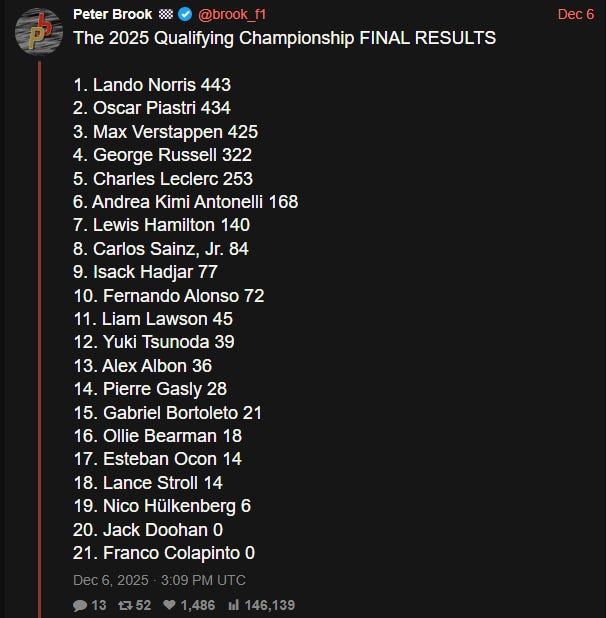
Lando Norris won the award, after both he and Piastri made it to Q3 in every single round this season.
Max Verstappen A and B Sprint Championships
These awards treat the Sprints as their own championship, much the same as qualifying.
The A Sprint Championship is by scoring the Sprints by what their real championship points distribution was, which for 2025 was a one-to-eight scale for the top 8 finishers. Here are the standings for that:
Max Verstappen - 32
George Russell - 30
Lando Norris - 29
Oscar Piastri - 29
Lewis Hamilton - 21
Charles Leclerc - 17
Kimi Antonelli - 15
Yuki Tsunoda - 12
Carlos Sainz - 10
Fernando Alonso - 5
Lance Stroll - 4
Esteban Ocon - 4
Alexander Albon - 3
Oliver Bearman - 2
Pierre Gasly - 2
Isack Hadjar - 1
The Sprint B Championship is by scoring the Sprints by the Grand Prix points distribution, the traditional 25 for a win, 18 for second place, etc.
Lando Norris - 84
Max Verstappen - 79
Oscar Piastri - 79
George Russell - 75
Lewis Hamilton - 58
Kimi Antonelli - 42
Charles Leclerc - 42
Yuki Tsunoda - 32
Carlos Sainz - 27
Fernando Alonso - 24
Lance Stroll - 14
Esteban Ocon - 10
Alexander Albon - 9
Pierre Gasly - 9
Isack Hadjar - 8
Oliver Bearman - 6
Liam Lawson - 3
Nico Hulkenberg - 2
Gabriel Bortoleto - 2
Lewis Hamilton Rookie of the Year Award
This is such a goofy idea, but stick with me.
We’re going to use the old NASCAR Rookie of the Year system. No, not the current one that is simply the most points wins RotY. The old, confusing one.
Rookies earn one point for entering a race prior to the entry deadline. How I define this is, if a rookie is added to the car on Saturday after a Friday of practice, that does not count for rookie points.
The highest finishing rookie earns 10 points, second highest earns 9 points, and so on and so forth.
If a rookie finishes in the top 10 of a race, they score bonus points based on where they finished. A win earns 10 bonus points, second 9 bonus points, and so on and so forth.
If this doesn’t sound convoluted enough, don’t worry, we’re not done yet. The season is divided into three seperate 8 race segments. The rookie with the most championship points, not rookie points, in each individual segment gets 10 bonus points. Second gets 9, and so on and so tired.
The rookie driver highest in championship points at season’s end scores 10 bonus points, with no bonus for second place.
Just to make things even worse, only a rookie’s best 12 races count in a season as far as rookie points are concerned.
There were four qualified rookies on the year: Kimi Antonelli, Isack Hadjar, Gabriel Bortoleto and Jack Doohan. Oliver Bearman was not technically a rookie to begin the year, as he had made three F1 starts prior to it. Liam Lawson and Franco Colapinto are also eliminated due to their number of starts prior.
After too much work, here is the rookie of the year standings:
1st. Kimi Antonelli - 247
2nd. Isack Hadjar - 184
3rd. Gabriel Bortoleto - 141
4th. Jack Doohan - 60
And so, the Rookie of the Year wa-
Wait a minute, there’s one more layer here. A five member panel then intervenes, one of whom is the previous season’s driver’s champion, and meets during the final week of the season. To quote the most trustworthy source on this directly (Wikipedia):
“They evaluate that year’s candidates on the following criteria:
Conduct with officials
Conduct and awareness on the racetrack
Personal appearance and conduct with the media
The panel may penalize rookies for any conduct that may be detrimental to NASCAR.
Anyone involved with a rookie candidate (such as a teammate or car owner) may NOT serve on that year’s panel and will be replaced by another persin in that category. In case of the Series Champion, it is the preceding year’s Series Champion. In 2002, Bobby Labonte served a second consecutive term on the Cup rookie panel as NASCAR disqualified Jeff Gordon from the position because of his equity ownership in Jimmie Johnson’s #48 car. Labonte had served on the 2001 season panel because of his 2000 championship.”
So, I guess Lewis Hamilton (ironically) would be meeting and deciding the rookie of the year but not really in a way, because Verstappen would be disqualified as Hadjar is part of the Red Bull family and…
Okay, forget all of this. Kimi Antonelli wins Rookie of the Year. Nobody had any conduct detrimental to NASCAR, in part because they don’t drive in NASCAR.
Historical Championship
Finally, there is this award, which recalculates the season using the 90’s 10-6-4-3-2-1 system, with any Sprints using the original 3-2-1 point distribution.
This is because that system is very adaptable and can be used to calculate every F1 season, as every driver has always wanted to finish in the top 6 at least in every race, and it allows for one more point to the winner while not adding too many points to second and third like the 2002-2009 system did.
The historical standings:
Lando Norris - 144
Max Verstappen - 141
Oscar Piastri - 137
George Russell - 82
Charles Leclerc - 55
Kimi Antonelli - 31
Lewis Hamilton - 23
Carlos Sainz - 11
Alexander Albon - 9
Nico Hulkenberg - 6
Isack Hadjar - 6
Oliver Bearman - 5
Fernando Alonso - 3
Esteban Ocon - 2
Liam Lawson - 2
Lance Stroll - 1
Yuki Tsunoda - 1
Gabriel Bortoleto - 1
Pierre Gasly - 0
Franco Colapinto - 0
Jack Doohan - 0
And just for fun, here’s the constructor standings:
McLaren - 281
Red Bull Racing - 142
Mercedes - 113
Ferrari - 88
Williams - 20
Racing Bulls - 8
Kick Sauber - 7
Haas - 5
Aston Martin Aramco - 4
Alpine - 0